National State of Emergency
Secret InvasionThe National State of Emergency is the federal declaration that transforms the Sligger crisis from a spreading coastal danger into a nationwide emergency response. Announced after a second wave of migration and attacks widened the perceived threat, it paired a national warning with military deployment. Its significance lies not only in the scale of the response, but in the change in scale it records: scattered reports and local precautions now demand coordinated action across regions and jurisdictions.
From scattered attacks to a national threat
The declaration follows mounting evidence that the creatures were not confined to a single nest or stretch of coast. After hearing of attacks in two locations too far apart to be related, Denise concluded that multiple nests, eggs, and creatures must be distributed along the coast. The possibility that people would not know where the danger lay until another attack made a national warning urgent. Eaver asked whether someone in government could issue one, and Denise identified her contact at the U.S. Fish and Wildlife Service as a route for notifying federal authorities.
The geography continued to widen. A Florida sheriff reported two separate attacks in one night: one near the eggs found at St. Augustine Beach and another near Sawgrass, about twenty miles north. Later reports placed attacks in the Gulf states. Texas emerged as the westernmost reported point, in Port Arthur on the Texas-Louisiana border. The president’s address explicitly tied the emergency to the discovery of a second wave of Sligger migration, framing the new spread as a broader threat rather than an isolated recurrence.
Declaration and public communication
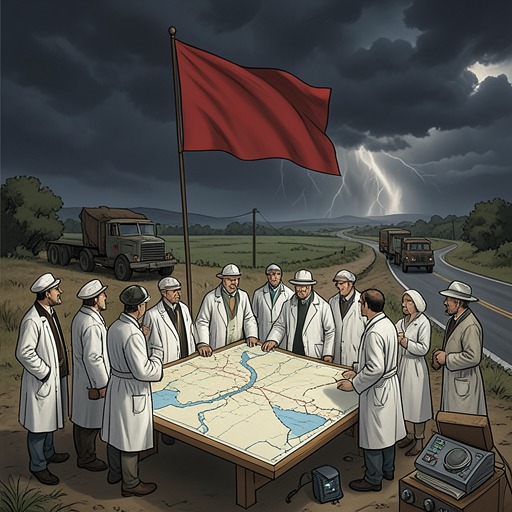
The president announced the National State of Emergency in a televised address from the White House Press Briefing Room. The national news bulletin Molly Foster watched reported that troops from the National Guard and the Army Reserve would be deployed to help contain and eliminate the spread. The declaration thus reached people not through a local official at an attack site, but through a direct national broadcast that connected distant outbreaks to a shared crisis.
That broadcast sits within a developing chain of risk communication. Earlier, officials had considered how to alert the public without provoking panic, while still warning people and informing police departments along the coast. By the time of the national coverage, viewers were being advised to stay indoors at night and away from the water until authorities declared areas safe. News and social media carried the warnings beyond official channels; humorous Sligger memes appeared alongside the formation of civilian hunting groups. The contrast captures the uneven texture of public response: danger became common knowledge, but it was processed through fear, practical precautions, humor, and attempts at collective action.
Deployment and the search for a strategy
The announced deployment gave national resources a role in a response that had previously depended heavily on local knowledge and law enforcement. Subsequent reports described troops arriving in Port Arthur, considered a possible origin point for the current migration, to assist local officers in searching near waterways and locating creatures and nests. The search was expected to cover the shorelines of every lake, inlet, and river in the county. The president also identified rapid reproduction as a danger to both public safety and the ecosystem, and did not rule out bioterrorism as a cause of the new spread; the possibility was presented as unresolved, not established fact.
As further attack sites appeared west of the forces already operating in Florida, the response had to account for a much larger map. Ron proposed dividing the troops among three priorities: sending a third to Port Arthur, continuing westward from Florida with another third, and moving the remainder to the Mississippi River to follow the creatures’ trail upstream. This proposed distribution makes the declaration’s practical problem visible. National mobilization supplied personnel, but reports still had to be gathered and translated into searches across separate waterways and jurisdictions.
Local consequences and narrative significance
The emergency altered daily life before and after the formal declaration. In Sweetboro, where memories of the previous year’s attack remained fresh, residents locked their homes and left for inland relatives, while others boarded windows, stocked ammunition, and cleaned their guns. Mason walked among his constituents, promising to prevent the creatures from gaining a foothold and asking residents to watch for eggs or nesting signs. He also directed them to report discoveries to him and leave dangerous intervention to the sheriff’s department. The scene shows local reassurance and self-protection operating alongside the broader escalation.
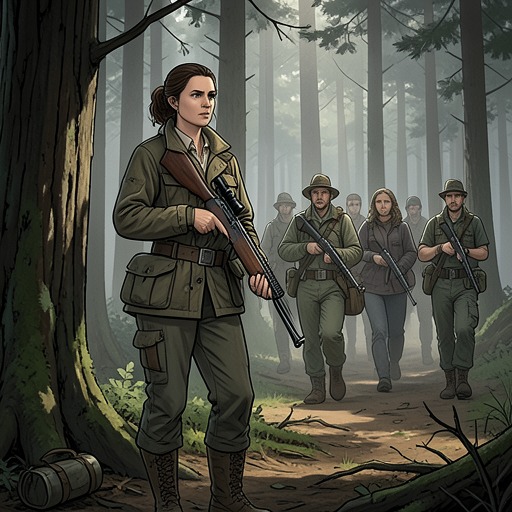
In Savannah, national broadcasts urged people to avoid the water, and police concentrated their searches near the Savannah River after the campground attack on Jekyll Island. Civilian hunters also organized outside populated areas; Molly Foster, raised in a military family and comfortable with firearms, assembled friends for a search. After the presidential bulletin, she called a deputy who had responded to the aftermath of her group’s earlier nest-clearing efforts, seeking more information. The declaration therefore did not erase local initiative: it entered a landscape already shaped by local policing, volunteer searches, and residents’ knowledge of nearby waters.
The broadcast also sharpened the stakes for Oscar Brown. Hearing that troops were coming to Port Arthur and that authorities suspected someone in town might have initiated the spread, he feared investigators could trace the creatures back to Brittney’s house and then to him. The president’s mention of possible bioterrorism remained a possibility rather than a finding, but for Oscar it gave public language to a private danger: his vengeful act might be exposed. In this way, the emergency links a national campaign against an ecological and public-safety threat to the concealed human cause of one part of its spread.